Practice at Home
Gripping the sword
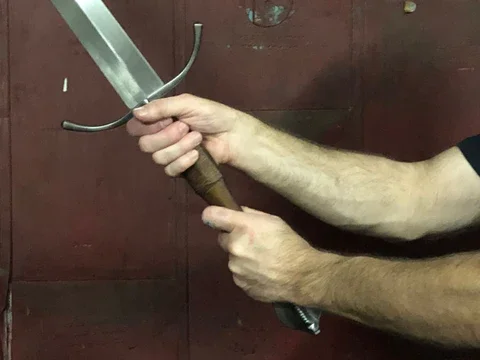
1. Place Your Dominant Hand on the Upper Grip
Your dominant hand goes just below the crossguard.
Wrap your fingers firmly but not tensely—think secure, not clenched.
The thumb can rest along the flat or wrapped around the grip depending on the tradition
2. Place Your Off-Hand Near the Pommel
Your non-dominant hand grips the sword at the lower end of the handle, usually touching or just above the pommel.
This hand acts as the steering and power hand, helping control blade rotation and leverage.
3. Hands Should Not Touch
A small gap between the hands is normal.
They shouldn’t be squished together—this reduces leverage.
4. Angle the Hands for Natural Alignment
Your knuckles on both hands should angle slightly forward, aligning your wrists with the blade’s direction.
Avoid bending your wrists sharply inward or outward.
5. Maintain a Relaxed but Ready Grip
The grip should be mostly relaxed, tightening only at the moment of a cut, parry, or bind.
A death grip limits mobility and tires you quickly.
6. Let the Pommel Move
The pommel should be able to rotate slightly in your off-hand during cuts—this helps the blade track smoothly.
Think of the lower hand as guiding the sword, not locking it in place.
7. Align the Edges
Ensure the true edge (your main cutting edge) lines up with your knuckles.
Proper edge alignment is essential for effective cuts and safe practice.