Practice at Home
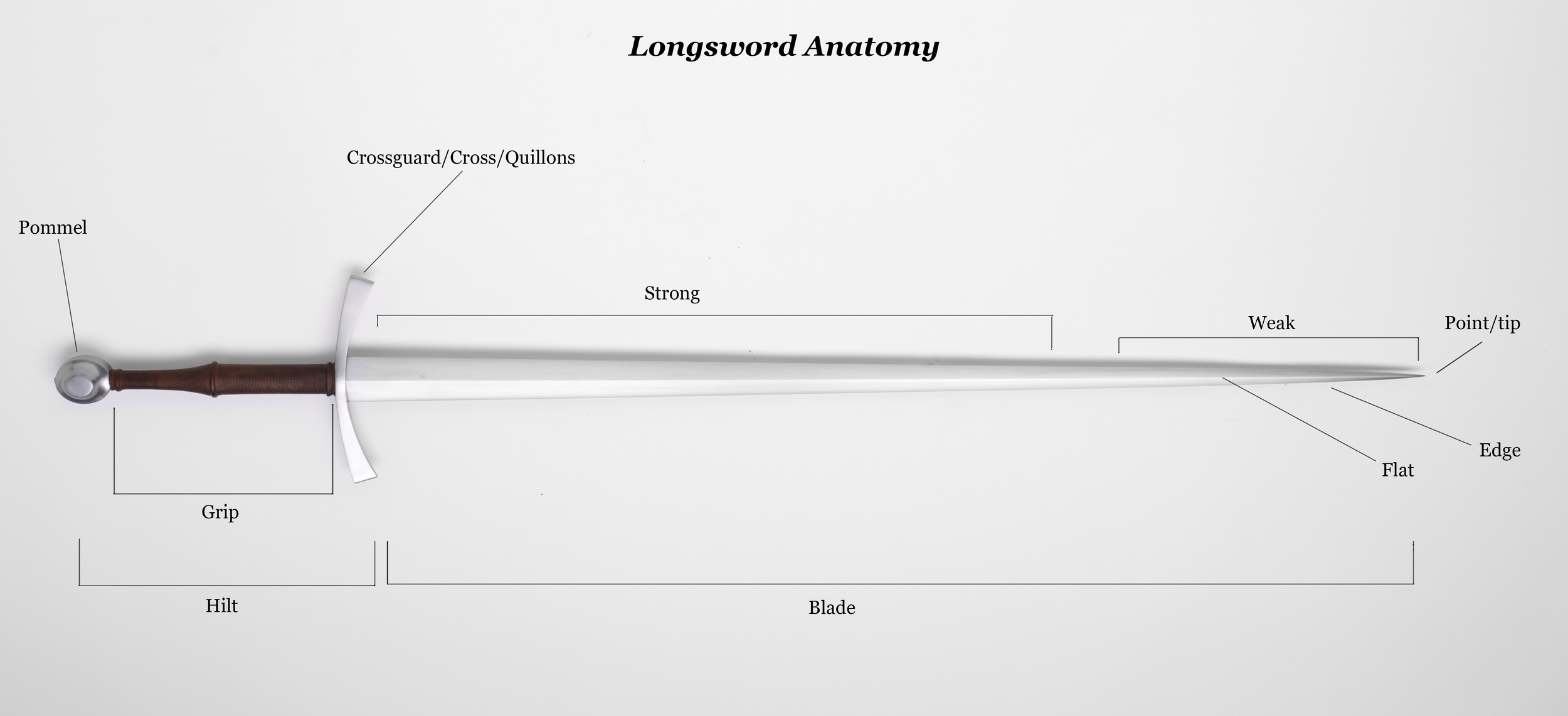
Blade: The main cutting part of the sword; the long, flat metal portion extending from the hilt to the point.
Point: The tip of the blade, used for thrusting.
True Edge: The primary cutting edge of the blade, usually facing outward when the sword is held normally.
False Edge: The secondary edge (often the back edge). It may be sharp, partially sharp, or unsharpened depending on the sword type.
Flat: The broad sides of the blade, between the edges.
Strong: The lower portion of the blade (closest to the hilt), used for parrying because it offers the most control and leverage.
Weak: The upper portion of the blade (near the point), used for cutting and reaching but offering less leverage in binding.
Hilt: The entire handle assembly, including the grip, guard, and pommel.
Crossguard/Quillons: The horizontal bar between blade and grip that protects the hand and helps control the opponent’s blade.
Grip: The part of the hilt held by the hand; often wood, leather, cord, or wrapped materials.
Pommel: The weight at the end of the hilt that balances the blade and secures the grip; sometimes used for striking.